THE STORY BEHIND
The Chapman Revolution - The Birth of a Football Power
White sleeves, tactical innovation, an Underground station and Arsenal’s first major trophies Herbert Chapman changed far more than just results.

ABOUT HERBERT CHAPMAN
Herbert Chapman - The Man Who Built Modern Arsenal
If you think Pep Guardiola represents the ultimate football innovator or that the greatest Arsenal side must automatically be one of Arsène Wenger’s teams, there is another figure you need to know. His name was Herbert Chapman.
Almost a century before modern coaches began talking about positional play, sports science, structured recruitment and carefully designed training methods, Chapman was already questioning how football clubs should work. And he did more than introduce a few tactical ideas.
He changed the way players trained. He changed the way teams were organised. He changed Arsenal’s identity. He changed Highbury. He even helped change the name of a London Underground station.
Most importantly, he helped transform Arsenal from a club still searching for its first major trophy into the foundation of a team that would dominate English football during the 1930s. The Wenger era produced the Invincibles. Chapman helped create something arguably just as extraordinary for its own time: the first great Arsenal dynasty.
A manager before managers were really managers.
To understand why Chapman was different, you have to understand football management in the 1920s. Managers did not normally control clubs in the way they do today. Team selection could still involve directors, training was relatively simple and many managers had limited involvement in the broader football operation.
Chapman wanted much more control. At Huddersfield and later Arsenal, he became involved in tactics, recruitment, scouting, reserve teams, training and player development.
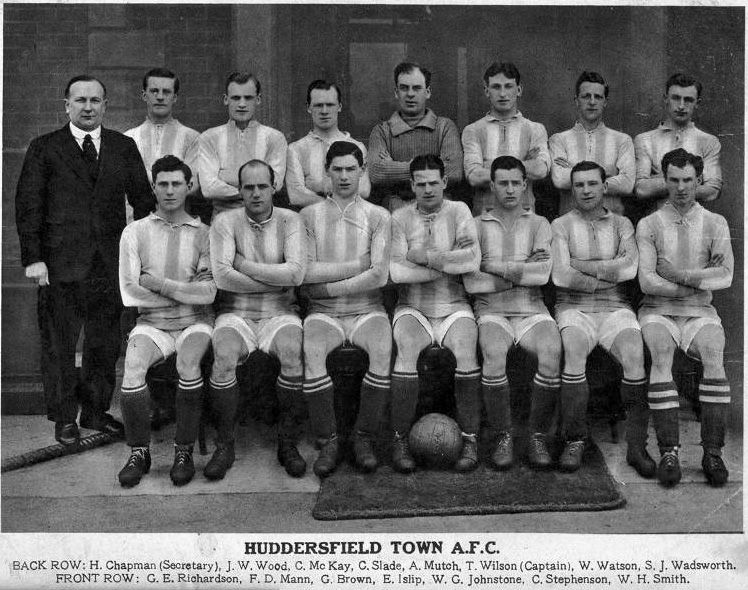
He wanted to improve players, not just pick the team.
Chapman was among the managers pushing football towards a more professional approach to preparation. He believed strongly in physical conditioning and structured training. He introduced stricter training routines, supported the use of physiotherapy and massage, and treated fitness as something that could be deliberately managed rather than simply assumed.
He was also interested in the development of individual players. Instead of focusing exclusively on the first XI, Chapman paid serious attention to the teams underneath it. At Huddersfield, his reserve and third teams were encouraged to play in the same way as the senior side, meaning that players promoted to the first team already understood the system.
Today, the idea sounds obvious. Academies, reserve sides and first teams are often expected to share a football philosophy. In the 1920s, it was anything but obvious.
Chapman also encouraged players to discuss tactics rather than simply follow instructions. Weekly conversations about football formed part of his approach, helping players understand why they were being asked to do something rather than merely what they were supposed to do. That was a remarkably modern concept.
He changed Arsenal away from the pitch too
Chapman’s influence was not limited to training sessions and matchdays. He understood that a football club also had an identity. Arsenal became one of his great projects.
Floodlights at Highbury
After seeing floodlit football on the continent, Chapman became an enthusiastic supporter of playing under artificial light. Floodlights were installed as part of Highbury’s redevelopment during his era. They could be used for training, although regulations meant Arsenal had to wait until the 1950s before floodlit competitive matches became a normal part of life at the stadium. Even so, Chapman was already thinking about how football could look in the future.
Numbers on shirts
Chapman also supported experiments with numbered shirts, another idea that was far from standard in English football at the time. Today it is impossible to imagine football without numbers. Then it was innovation.
The white sleeves
His most visible contribution survives every weekend. In 1933, Arsenal changed their previously red shirt by adding distinctive white sleeves. The basic red-body-and-white-sleeves design has remained part of Arsenal’s identity ever since. It is difficult to find another managerial decision from the 1930s that is still so immediately visible in a club’s identity almost a century later.
He even changed the Underground map
There was the Tube station. The station nearest Highbury had originally been called Gillespie Road. Chapman understood the value of Arsenal’s name and pushed for it to be changed. In 1932 it became Arsenal (Highbury Hill), later simplified to simply Arsenal. A football manager had effectively placed his club onto the map of London. Literally.
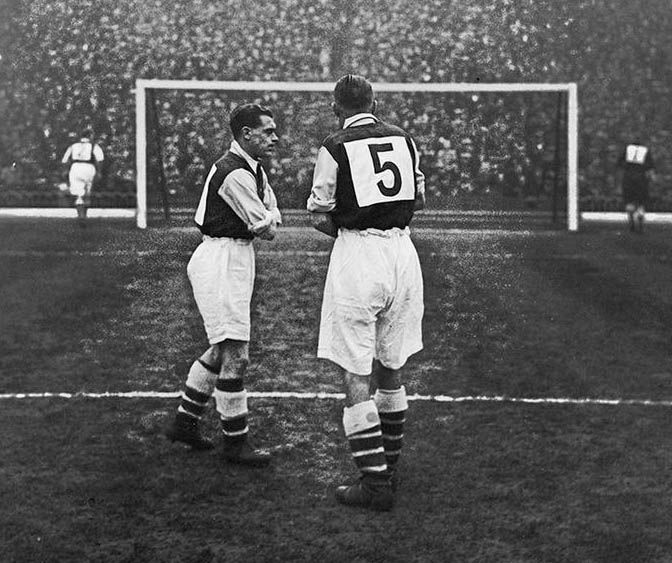
Then came the tactical revolution
Chapman’s most famous contribution, however, happened on the pitch. Before the mid-1920s, English football was still strongly associated with the 2–3–5 formation, the famous pyramid. Two defenders. Three half-backs. Five forwards.
It was a structure born in an era when football was far more attack-heavy and positional responsibilities were very different from those we recognise today.
Then the offside law changed in 1925. Previously, an attacker needed three opposition players between himself and the goal line to remain onside. The new law reduced that number to two. Suddenly, attackers had much more space. Goals increased. Defences had a problem. Arsenal needed an answer.
From 2–3–5 to WM
The solution associated with Chapman and Arsenal was the WM formation, usually represented as 3–2–2–3. One of the half-backs dropped deeper to become something much closer to a modern central defender. Two deeper midfield players provided another layer of protection, while two inside forwards operated between midfield and the front three. Viewed on a tactics board, the defensive half resembled an M, while the attacking five formed a W. Hence: WM.
Chapman should not simply be described as the sole inventor of the system. Similar ideas were developing elsewhere, and Arsenal captain Charlie Buchan played an important role in the tactical discussions that led to Arsenal’s version.
What Chapman did exceptionally well was refine it, organise it and build one of the most successful teams in England around it. Football became more controlled The change was about far more than adding another defender. Chapman wanted Arsenal to control space.
Instead of attacking continuously in the frantic style associated with earlier English football, his team could deliberately allow opponents to come forward before attacking the space they left behind. That meant football could be slowed down intentionally. The opposition could be drawn out. Then Arsenal could attack rapidly.
Chapman believed that the moment immediately after recovering the ball was one of the best opportunities to score, because the opposition would be spread out and vulnerable. His Arsenal became strongly associated with fast counter-attacks, quick passing and dangerous wide players.
In many ways, it sounds surprisingly modern. New jobs appeared on the pitch. The WM also encouraged greater specialisation. The centre-half became increasingly defensive. Inside forwards could drop deeper and become creators. Wingers remained high and wide, ready to attack quickly. The goalkeeper could also operate more actively behind the defensive line instead of simply waiting on his goal line. Rather than five players simply attacking and five defending, the team became a system of interconnected roles.
This is one reason Chapman is sometimes presented as one of football’s great tactical inventors. It would be an exaggeration to say that he personally invented every position we recognise today. But his teams helped accelerate the transition toward the specialised defenders, midfield creators, wide attackers and structured positional roles that became fundamental to modern football.
The strengths of Chapman’s system
The beauty of the WM was that it could look defensive on paper while producing extremely attacking football. Arsenal had three recognised defenders and protection in midfield, but when possession was regained they could release their forwards very quickly.
The system offered several major advantages:
Chapman’s Arsenal were not simply trying to overwhelm opponents with numbers.
They were trying to attack at the right moment. And when the system worked, it could be devastating. But it demanded intelligent players, the downside was complexity. Players needed to understand their exact role. A defender stepping out at the wrong moment could destroy the structure. An inside forward dropping too deep or too late could leave the attack isolated. The entire team needed to understand when to defend, when to slow the game down and when to suddenly accelerate.
That meant the system required:
And that links directly back to Chapman’s broader philosophy. His tactics could not exist separately from his training methods. The system demanded better-prepared players, so Chapman tried to create better-prepared players.
And then came the trophies
The remarkable thing is that Chapman had already demonstrated his methods worked long before Arsenal. At Northampton Town, he won the Southern League in 1908/09. His team also earned attention for strong performances against Football League opposition in the FA Cup.
He later moved to Leeds City. Progress toward promotion proved difficult and the First World War eventually interrupted league football altogether.
Then came Huddersfield Town. In his first full season, Huddersfield won the 1922 FA Cup. Then they became English champions in 1923/24 and again in 1924/25.
Chapman had turned Huddersfield into the dominant side in England. Arsenal noticed. Building the first great Arsenal. Chapman arrived at Highbury in 1925. Arsenal had never won a major trophy. Five years later, that changed.
In 1930, Arsenal beat Chapman’s former club Huddersfield Town 2–0 at Wembley to win the club’s first FA Cup - the first major trophy in Arsenal history.
Then came the league:
1930/31 — First Division champions.
1931/32 — FA Cup finalists and league runners-up.
1932/33 — First Division champions again.
By then Chapman had created something much bigger than a successful team. He had built the foundation of a dynasty. The team kept winning after he was gone. Chapman never saw the full extent of what he had created. In January 1934, after contracting pneumonia, he died suddenly at the age of just 55. Arsenal were already in the middle of another title campaign. They went on to become champions in 1933/34. Then again in 1934/35. And once more in 1937/38.
Those later championships were not won under Chapman himself, so they should not simply be added to his personal honours. But they reveal something perhaps even more important. The structure he created survived him. The players, tactical principles and modernised club he had helped build continued to dominate English football. That may be Chapman’s greatest achievement. The Guardiola before Guardiola? Comparing managers from completely different eras is almost impossible. Guardiola works with video analysis, enormous coaching staffs, GPS tracking and almost unlimited tactical information. Chapman worked in a world without substitutes, television analysis or even floodlit league football. But the mentality feels familiar. Do not accept football simply because that is how it has always been played.
Question it. Analyse it. Improve training. Improve tactics. Improve recruitment. Improve the stadium. Improve the identity of the club. Then make all of those things work together.
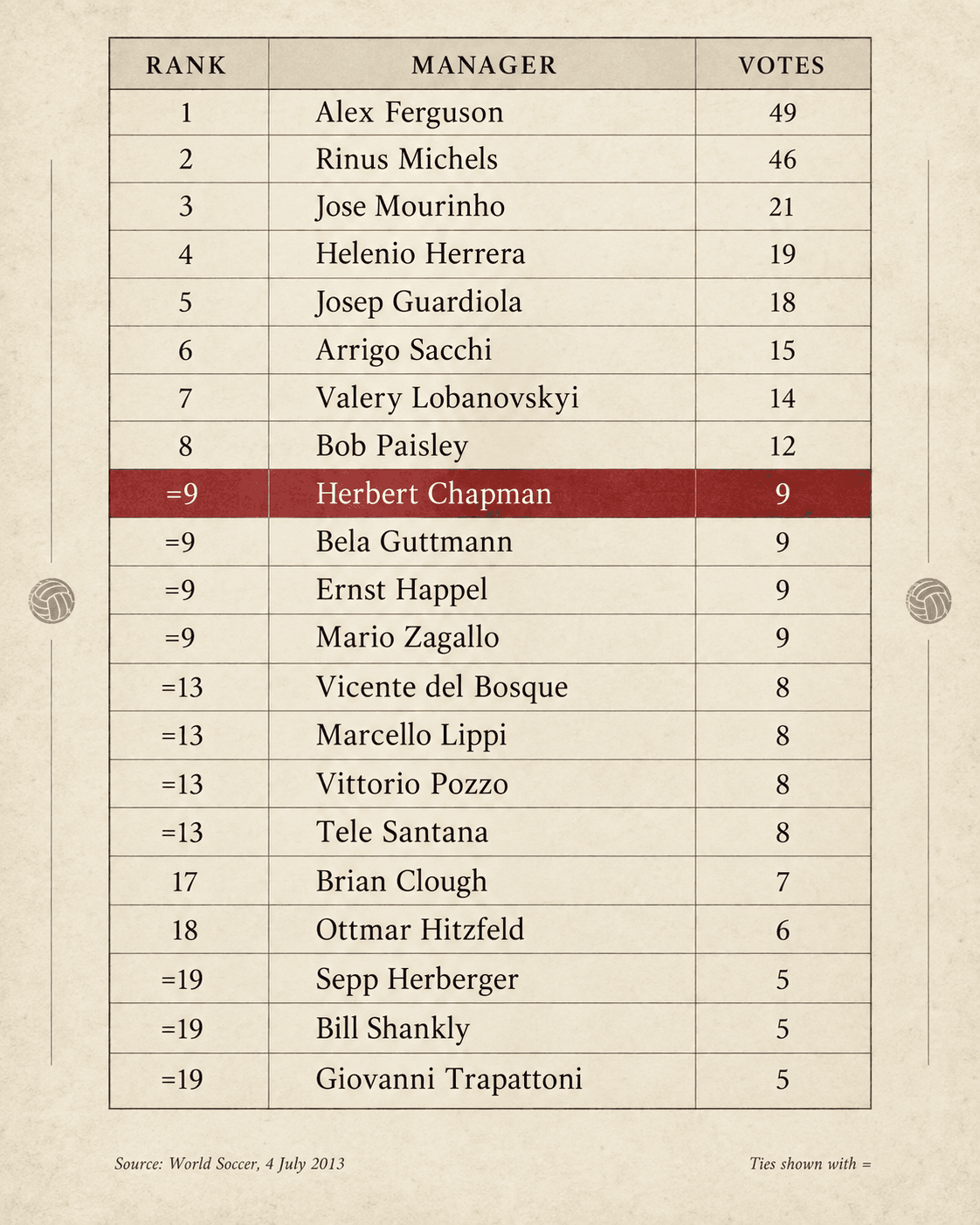
In 2013, World Soccer placed Chapman ninth in its list of the greatest managers of all time.
Almost ninety years after his death, Arsenal still play in white sleeves. Supporters still arrive at Arsenal station. And tactical historians still discuss the WM. Herbert Chapman did not simply build a great Arsenal team. He helped redefine what a football manager could be.
TEAMS
1 connectedSTORIES
1 publishedWhite sleeves, tactical innovation, an Underground station and Arsenal’s first major trophies Herbert Chapman changed far more than just results.