
When Herbert Chapman arrived at Arsenal in 1925, the club was not yet the giant it would later become. Arsenal had moved to Highbury more than a decade earlier, but major success was still missing. Chapman changed that. In less than ten years, he helped transform Arsenal’s results, tactics, image and even its place on the map of London.
Here are six reasons why his influence on the club was so important.
1. He delivered Arsenal’s first major trophies
The most obvious change was success. In 1930, Arsenal won the FA Cup, beating Huddersfield Town in the final. It was the first major trophy in the club’s history. The breakthrough was followed by league titles in 1930/31 and 1932/33. For the first time, Arsenal were not simply a club with potential. They were becoming one of the strongest teams in England. Chapman did not just win trophies. He changed expectations.
2. He helped revolutionise Arsenal’s tactics
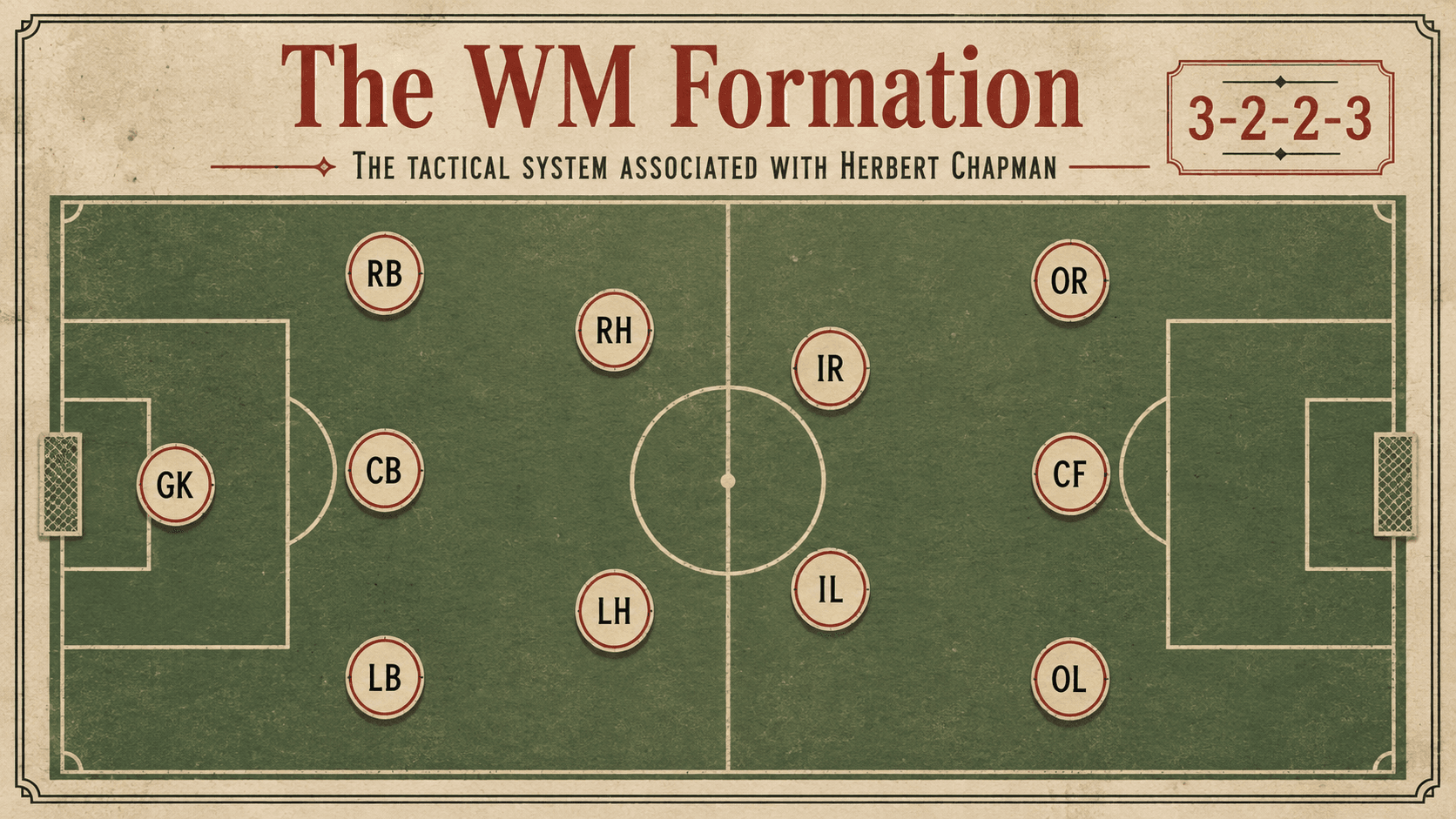
Chapman is strongly associated with the development of the famous WM system. After the offside law changed in 1925, teams suddenly had to rethink how they defended. Chapman, together with players such as Charlie Buchan, adapted quickly. The new structure gave Arsenal greater defensive security while also allowing them to attack quickly and directly. It would be an exaggeration to say Chapman invented the system entirely by himself, but Arsenal became one of the teams most closely associated with it. His real strength was recognising that football had changed and changing faster than others. Chapman’s thinking went beyond formations. He believed that too much emphasis on results could actually make football worse. Players, afraid of losing points, became less willing to take risks and express themselves.
As he wrote: “The average standard of play would go up remarkably if the result were not the all-important end of matches. Fear of defeat and the loss of points eat into the confidence of players…” He went even further, arguing that if football was to improve, the game needed to find a way of “minimising the importance of winning and the value of points.”
It was an unusually idealistic view for a manager operating at the highest level. Chapman understood that results mattered, but he also believed football should remain attractive, expressive and worth watching. For a man so closely associated with tactical discipline and efficiency, that makes his philosophy even more interesting: he wanted structure without killing creativity.
3. He helped create Arsenal’s iconic white sleeves.
One of the most recognisable features of Arsenal’s identity also dates back to Chapman’s era. In 1933, the club adopted shirts with a red body and white sleeves. That design became one of the most distinctive kits in English football and remains central to Arsenal’s visual identity today. It may seem like a small detail compared with trophies and tactics, but it is a perfect example of Chapman’s wider influence. He was not only building a successful team. He was helping build a recognisable club.
4. He helped put Arsenal on the London Underground map.
Chapman understood the importance of visibility. Near Highbury stood a London Underground station called Gillespie Road. Chapman pushed for the station to be renamed after the football club. In 1932, it became Arsenal. That made the club impossible to miss for thousands of Londoners travelling through the city. Even today, Arsenal remains uniquely associated with its own Underground station. For Chapman football was not only about what happened on the pitch. The club had to become part of the city itself.

5. He modernised the way Arsenal operated
Chapman thought about football in a way that was unusually modern for the 1920s and 1930s. For him, managing a team was not simply about picking eleven players on Saturday afternoon. He was interested in everything that could give Arsenal an advantage: training, fitness, diet, tactics, technology and even the experience of supporters inside the stadium. Training became more deliberate. Arsenal experimented with specialist equipment designed to improve a player’s speed of control and passing, and Chapman supported the idea that technique could be sharpened through repetitive focused practice.
He also paid close attention to preparation and tactics. The development of Arsenal’s WM system was not simply a formation drawn on a board. It reflected a broader belief that teams had to study how football was changing and adapt accordingly. Chapman was equally interested in innovation away from the training ground. He encouraged experiments with floodlit football and the use of a white ball, ideas intended to make the game easier to follow. He was also behind the installation of the famous Highbury clock, originally designed to count down the 45 minutes of each half before the Football Association objected. Highbury itself became a showcase for a more modern kind of football club. In 1927, it hosted the first live radio commentary of a league match, when Arsenal played Sheffield United.
Chapman understood something that feels completely normal today: a football club was not only a team. It was training, tactics, infrastructure, media, presentation and identity. Almost a century before clubs began talking about marginal gains and performance departments, Chapman was already searching for small improvements everywhere he could find them.
6. His Arsenal kept winning after he was gone
Perhaps the strongest evidence of Chapman’s impact came after his death. He died suddenly in January 1934, aged only 55. His work, however, did not disappear with him. Arsenal went on to win the league in the same season and continued to dominate English football during the 1930s. That is what made Chapman’s legacy so powerful. He had not simply created a successful team for one or two seasons. He had helped create a structure, identity and winning culture strong enough to survive without him.
Before Herbert Chapman, Arsenal were still searching for their place among England’s biggest clubs. After him, they had become one of them.