
From the World's Best to Rock Bottom
In our three-part comparison of Europe's Big Five leagues, the Premier League came out on top in popularity, financial power and European performance. By our chosen measures, England had the strongest football league in Europe. But how did it become so dominant? To find the answer, we need to travel back to the 1980s. Back to a time when English football looked nothing like the global powerhouse we know today. Stadiums were ageing, attendances were declining and financial difficulties were affecting clubs across the country. Violence surrounding football had become a serious problem, while a series of tragedies would expose devastating failures in stadium safety. English clubs would even find themselves excluded from European competitions. There were no billion-pound television deals, no worldwide Premier League brand and little reason to imagine that English football was about to become one of the most powerful businesses in global sport. Yet within a few years, a group of ambitious club executives would help set a revolution in motion. And English football would never be the same.
English Football at Rock Bottom
By the mid-1980s, English football was in serious trouble. Many stadiums were ageing, with deteriorating terraces, outdated facilities and inadequate safety measures. Violence associated with football had become a major concern, while clubs were struggling financially and losing spectators. Even the simplest part of a matchday experience could be unpleasant. Half-time lasted just ten minutes, leaving supporters with little time to navigate overcrowded concourses and inadequate toilet facilities. At some grounds, the conditions were so poor that the smell of urine lingered around the terraces, and some supporters resorted to relieving themselves where they stood. For many fans, attending a match meant accepting conditions that would be almost unimaginable at a modern Premier League stadium.
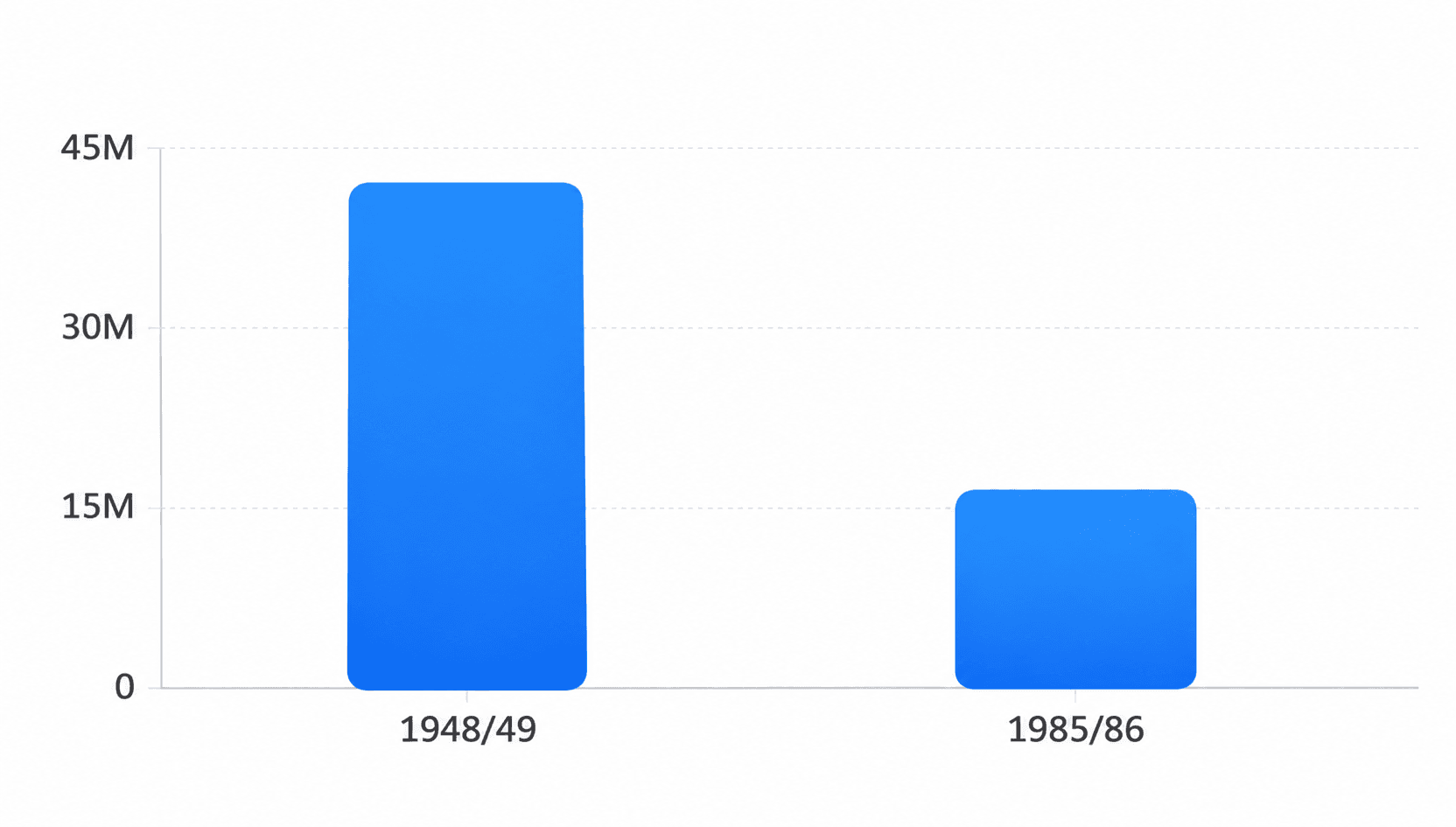
The numbers tell the story. In the 1948/49 season, matches across England's four Football League divisions attracted around 41 million spectators. By 1985/86, that figure had fallen to just 16.5 million. English football had lost roughly 60% of its annual attendance compared with its post-war peak. And the problems went far beyond empty terraces.
In May 1985, a fire at Bradford City's Valley Parade stadium killed 56 people, exposing serious shortcomings in stadium safety. Just eighteen days later, another tragedy struck European football. Before the European Cup final between Liverpool and Juventus at Brussels' Heysel Stadium, violence and a stadium wall collapse led to the deaths of 39 supporters. English clubs were subsequently banned from European competitions for five years, with Liverpool facing an additional year. Four years later, in April 1989, 97 Liverpool supporters ultimately lost their lives as a result of the Hillsborough disaster, when a fatal crush occurred during an FA Cup semi-final against Nottingham Forest. Investigations established that failures in policing and stadium safety were central to the disaster, and that Liverpool supporters were not responsible.
Meanwhile, English football was failing to exploit its commercial potential. Television was often viewed with suspicion rather than as an opportunity. Many club executives feared that broadcasting matches would discourage supporters from attending games. In 1985, a dispute over television rights became so serious that Football League coverage disappeared from British television for months. Financial difficulties were widespread, sponsorship opportunities were comparatively limited and clubs remained heavily dependent on money generated at the stadium gates. It was a striking contradiction. England had some of the world's most historic football clubs and a deeply rooted football culture, yet the game was struggling to adapt to a changing world. Something had to change. And while English football faced its darkest years, a small group of club executives had begun to see something others had overlooked: enormous untapped commercial potential.
The Men Who Saw an Opportunity
Not everyone looked at English football's problems and saw a dying industry. Some saw an extraordinary business opportunity. By the late 1980s, a group of influential executives from England's biggest clubs had become increasingly frustrated with the way the Football League operated. They believed the country's leading teams attracted the largest audiences and generated much of the commercial interest, yet had too little control over how the game was run and how television money was distributed. At the centre of this movement were five clubs: Manchester United, Arsenal, Liverpool, Everton and Tottenham Hotspur - the so-called Big Five. Their leading figures included Martin Edwards of Manchester United, David Dein of Arsenal, Irving Scholar of Tottenham, Philip Carter of Everton and Noel White of Liverpool. Dein was particularly fascinated by the commercial possibilities of American sport, where major sporting events were presented as entertainment products, combining television, marketing and sponsorship. He believed English football could learn from that approach. Another important figure was Greg Dyke, a senior television executive at London Weekend Television and ITV. Dyke recognised something the clubs themselves were beginning to understand: football's biggest matches could attract enormous television audiences, and broadcasters might be willing to pay considerably more for them. In 1990, Dyke brought representatives of the Big Five together for a dinner at London Weekend Television's headquarters in London. The discussion centred on an increasingly radical possibility: what if the leading clubs could negotiate their own television arrangements, rather than remaining tied to the existing Football League structure? For the clubs, it promised greater commercial freedom and a larger share of broadcasting revenue. For television companies, it offered access to some of the country's most attractive sporting content. But there was a problem. The existing Football League system was not designed to give its biggest clubs that kind of independence. Achieving it would require much more than negotiating a better television contract. It might require creating an entirely new league.
The Breakaway That Changed Football
The idea of creating a new league was radical, but the dissatisfaction behind it had been growing for years. Since 1888, England's league football had operated under the Football League, an organisation responsible for all four professional divisions. For more than a century, the country's biggest clubs had competed within the same structure as dozens of smaller teams. Now, the leading clubs wanted something different. They argued that the First Division generated much of English football's commercial value but lacked sufficient control over its own future. Television rights, sponsorship agreements and the distribution of revenue were all tied to the existing system. Breaking away would allow the top clubs to negotiate their own deals and retain a greater share of the money. Crucially, they found support from the Football Association (FA), which had its own disagreements with the Football League. The FA backed the idea of a new elite competition, arguing that restructuring could strengthen English football and create opportunities for commercial growth. In June 1991, the FA approved its blueprint for the future of the game. Then, on 17 July 1991, the First Division clubs signed the Founder Members Agreement, establishing the principles of a new competition with commercial independence from both the Football League and the FA. The decisive break came on 20 February 1992, when all 22 First Division clubs resigned from the Football League. Three months later, on 27 May 1992, the Premier League was formally established. After 104 years, England's highest division was no longer part of the organisation that had created league football in the country. But this was not a closed competition reserved for the biggest clubs. Promotion and relegation remained in place, preserving the connection with the divisions below. On the pitch, English football would still look familiar. Clubs would compete for points, championships and survival. Behind the scenes, however, everything had changed. The Premier League now had the freedom to sell its own television rights, negotiate sponsorship agreements and control its commercial future. And that independence was about to become extraordinarily valuable.
Football Meets Television
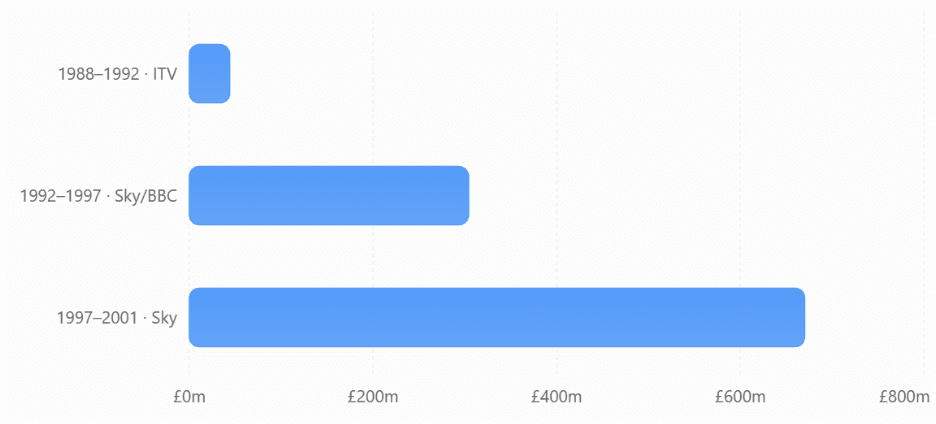
For decades, English football had treated television with suspicion. Many club executives feared that broadcasting matches would keep supporters away from stadiums, reducing the income they depended on. By 1992, that thinking was about to change dramatically. The Football League's previous television agreement with ITV, covering 1988–1992, had been worth £44 million over four years. Now, with the newly formed Premier League free to negotiate its own broadcasting rights, television companies suddenly found themselves competing for one of Britain's most attractive sporting products. Ironically, ITV was expected to win. Its executive Greg Dyke had played an important role in the discussions that helped bring the Premier League into existence. But another broadcaster had very different ambitions. BSkyB, backed by Rupert Murdoch, was trying to establish satellite television as a major force in Britain. Exclusive live football could give millions of households a compelling reason to subscribe. The decisive negotiations took place in May 1992. ITV and Sky were competing fiercely, while Tottenham chairman Alan Sugar, whose company Amstrad manufactured satellite television equipment, was also closely involved. During the final bidding process, Sugar reportedly urged Sky to make an offer ITV could not match. Sky won. The new agreement was announced as a package worth up to £304 million over five years, including live television rights, highlights and projected additional revenues. Sky's live broadcasting rights alone accounted for approximately £191.5 million, covering 60 matches per season. The BBC secured the highlights package, bringing Match of the Day back to Saturday evenings. It was a turning point. But the Premier League's success was not simply about negotiating bigger contracts. It was also about how the money was distributed. Under the league's revenue-sharing model, domestic broadcasting income was divided into three parts:
- 50% shared equally between clubs.
- 25% distributed according to final league position.
- 25% awarded according to television appearances.
The system rewarded success and television appeal while guaranteeing every club a substantial share of the income. Television was no longer just a way to watch football. It was becoming the financial engine of an entirely new sporting business. And the first Premier League season was ready to begin.
A New Era Begins
On 15 August 1992, the Premier League finally kicked off. Twenty-two clubs entered the inaugural season. Despite all the negotiations, television deals and promises of a new beginning, the football itself initially looked remarkably familiar.The first goal in Premier League history was not scored by a global superstar or one of England's most famous players. It came at Bramall Lane, where Brian Deane headed Sheffield United into the lead against Manchester United after just five minutes. Sheffield United went on to win 2-1.Elsewhere, clubs were beginning to experience a very different approach to presenting football. Sky introduced new broadcasting technology, extensive pre-match coverage and a more entertainment-driven style. Sunday afternoon fixtures and Monday Night Football became part of the new television experience, with the broadcaster promoting matches as major events rather than simply showing ninety minutes of football. The transformation was visible off the pitch, even if it would take years for its full financial consequences to emerge. At the end of that first season, Manchester United became the inaugural Premier League champions, ending a 26-year wait for the English league title. It was the beginning of a period of dominance for Alex Ferguson's team. But in 1992, nobody could know how far the competition would eventually grow. The Premier League had separated from the Football League, secured its own broadcasting deal and established a new commercial identity. The foundations were in place. What happened next would change not just English football, but the economics of the game around the world.
Conclusion - The Foundations Were Laid
Just a decade earlier, English football had been struggling with declining attendances, financial difficulties, violence and crumbling stadiums. By 1992, it had taken the first steps towards a completely different future. A group of ambitious club executives had challenged a century-old system, created a new competition and unlocked the commercial potential of television. But the Premier League's creation was only the beginning. Modern stadiums, global broadcasting deals, international superstars and foreign investment would transform the competition far beyond what its founders could have imagined.
The Premier League had been born. But how did it become the most powerful football league in the world? That is where the next chapter of our story begins.